Storm2Flow · Use case

Approvals with clear ownership.

Sign-off processes stall when no one knows who owns the next step or what threshold sends a request up a level. Storm2Flow turns your scattered approval rules into a clear process description plus the diagrams that match it, with explicit ownership and handoffs, then lets you compare As-is with To-be to remove the bottlenecks.

The messy starting point

The real approval rules rarely live in one place. The thresholds are in an email someone sent two years ago. The convention to "ask Finance first" is unwritten. Half the team routes purchase requests one way, half another. When an approval is slow, no one can say whether it is stuck with the manager, the budget owner, or the CFO, because the path was never written down as one thing.

You do not have to untangle that first. Storm2Flow takes the mess as it is: braindump bullets, a whiteboard photo of the flow you drew in a meeting, a pasted policy, or just talking through how approvals really run. Interpreting messy input is table stakes. The value is in what it becomes.

The hard part, made easy

The hard part of an approval workflow is not the diagram. It is agreeing, in plain language, on the rules and the ownership: who raises a request, who validates it, the thresholds that decide whether it is auto-approved or escalated, who signs off at each tier, what happens on rejection, and what the escalation is when no decision is recorded in time. Storm2Flow makes that the easy part. It turns your input into a clear, shared process description that requesters and approvers can all read and correct before any diagram exists.

Example starting input

A department head raises a purchase request via the portal, specifying items, quantity, supplier preference, and a budget code. Finance validates the budget code, available budget, and approval limits. If the value is below the department threshold it is approved automatically; above the threshold it routes to the CFO for sign-off. Once approved, Procurement issues the purchase order to the vendor.

Storm2Flow refines that into a precise description with every threshold and handoff spelled out, so the ownership is explicit rather than implied.

One description, the whole diagram set

From that single description, Storm2Flow generates the diagrams that match it, not just one picture:

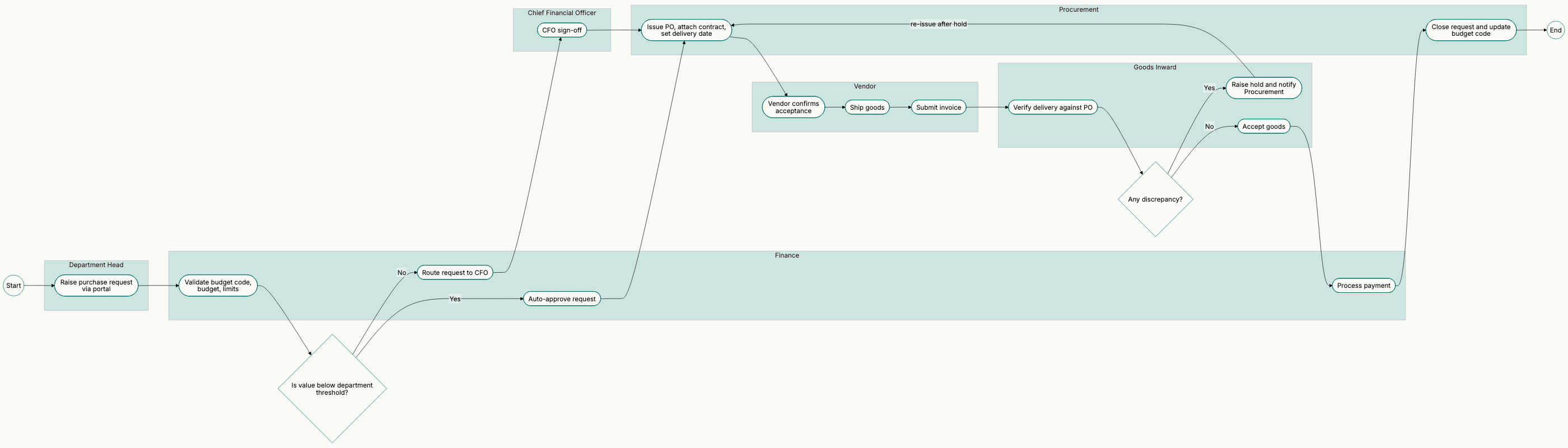
A swimlane diagram of a purchase-order approval flow generated by Storm2Flow, with lanes showing who owns each step across Finance, Procurement, and the vendor.
A swimlane Storm2Flow produced from a purchase-approval description; each lane makes ownership of a handoff explicit.

Guided, evolving, collaborative

Approval rules change as the organisation grows: new thresholds, a new approver tier, a new compliance check. In Storm2Flow the description and its diagrams are a living object. Show approvers and requesters the description and its diagrams; they comment on a span of the text or on the whole process, ask questions, and raise flags. You resolve them and evolve the description again, and every saved change is a restorable version.

This is where approvals get faster. Hold the As-is workflow and a To-be redesign side by side to find and remove the bottleneck, the redundant sign-off, or the threshold that sends too much to the CFO. Split the workflow into subprocesses, and keep the whole thing in a Space, your team's shared, living process library, so the rules are in one place instead of an email chain.

The operational value

The payoff for approval workflows is concrete: clear ownership and handoffs so a request never sits unowned, and an explicit As-is versus To-be comparison that turns "approvals feel slow" into a specific bottleneck you can remove. Requesters know where their request is, approvers know what is theirs to decide, and the rules live in one shared, evolvable description instead of scattered conventions.

See the other scenarios on the use cases page, or read the full picture on the FAQ.