Compliance is only as strong as the process behind it, but the controls usually live in regulations, spreadsheets, and people's heads. Storm2Flow turns that into a clear process description plus the diagrams that match it, so your controls are auditable, repeatable, and defensible instead of reconstructed from memory at audit time.
Most compliance processes are scattered. The requirements sit in a regulation or framework no one rereads. The controls live in a spreadsheet that one person maintains, half the checks happen because someone remembers to do them, and the evidence is wherever it last got saved. When an auditor asks how a control works, the answer is reconstructed from memory, and gaps only surface after a finding.
You do not have to clean that up first. Storm2Flow takes the mess as it is: rough braindump bullets from a controls review, a whiteboard photo of the approval chain you sketched, or just talking through how a check actually runs. Interpreting messy input is table stakes, not the point. The point is what comes next.
The genuinely hard part of compliance is not drawing a control chart. It is agreeing, in plain language, on exactly how a control should run: what triggers it, which checks must happen and in what order, who performs each one, what approvals are required, what evidence is captured and where, and how an exception is escalated and closed. Storm2Flow makes that the easy part. It turns your input into a clear, shared process description you can read, correct, and align on before any diagram exists.
When a new vendor is onboarded, the requester submits the vendor details and the procurement owner runs a risk screening. If the vendor is low risk, a manager approves and the vendor is activated. If it is high risk, the compliance team performs enhanced due diligence and collects evidence; legal signs off before activation. Every approval and document is recorded, and any unresolved flag blocks activation until it is closed.
Storm2Flow refines that into a precise description with the controls, approvals, evidence, and owners spelled out, so the process is the same every time it runs.
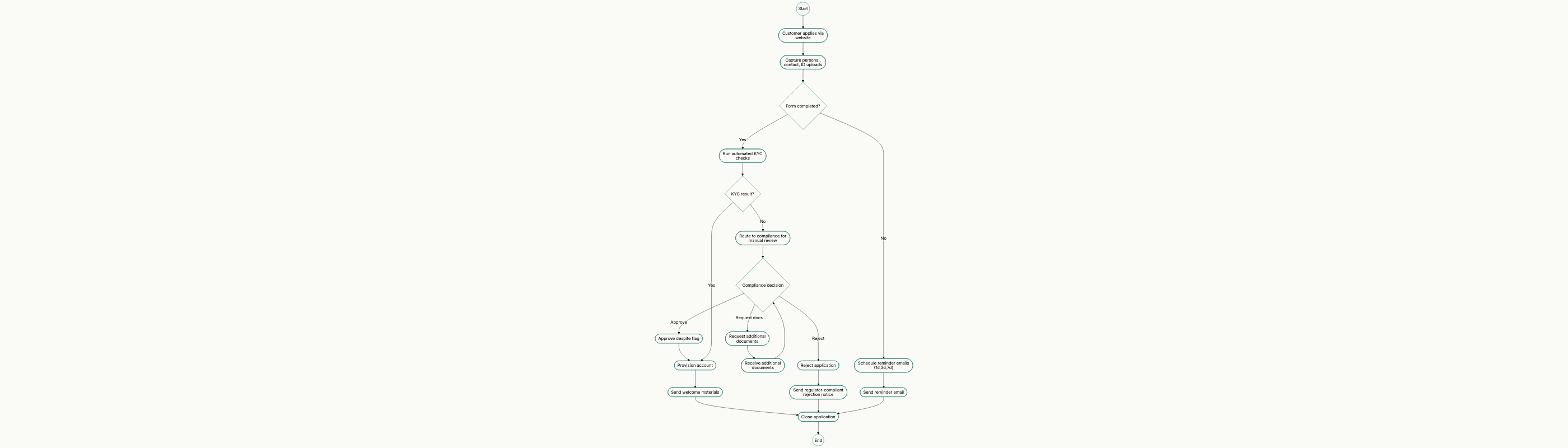
From that single description, Storm2Flow generates the diagrams that match it, not just one picture:
A control is only defensible if it is documented as it actually runs, and only stays defensible if it keeps pace with the rules. In Storm2Flow the description and its diagrams are a living object, not a one-shot export. Show control owners, reviewers, and auditors the description and its diagrams; they comment on a span of the text or on the whole process, ask questions, and raise flags. You resolve them and evolve the description again, and every saved change is a restorable version, so you can show exactly how a control looked at any point in time.
Compare the As-is controls with a To-be target to close a gap a finding exposed, split the process into subprocesses (screening, due diligence, approval, evidence, review), and keep the whole thing in a Space, your team's shared, living process library, so it is the one place owners and auditors point at instead of a scattered set of spreadsheets and docs.
The payoff for compliance is concrete: auditable, repeatable, defensible compliance because every control runs the same documented path with owners and evidence defined, an As-is versus To-be view that makes control gaps obvious so you can close them before a finding does, and a living control model that auditors and the team share instead of reconstructing the process from memory. The model improves after each review instead of decaying between audits.
See the other scenarios on the use cases page, or read the full picture on the FAQ.