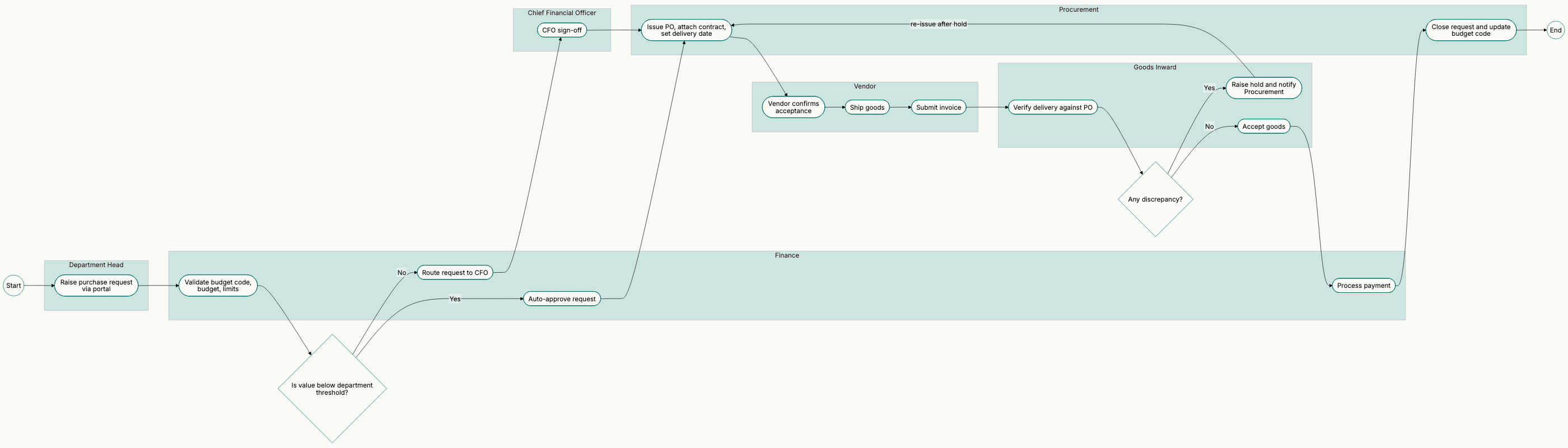
A good hire depends on a consistent process, but most hiring lives in fragments across email, an ATS, and people's heads. Storm2Flow turns that into a clear process description plus the diagrams that match it, so every role runs the same fair, auditable path and a new interviewer can onboard in minutes, not months.
Hiring is rarely written down end to end. The real process is split across email threads, an applicant tracking system, a shared drive of scorecards, and the tribal knowledge of whoever has hired for the team before. One panel asks for a take-home, another skips it. Some roles need a final approval, others slip through. When a new interviewer joins, they learn the steps by watching, and the candidate experience drifts from team to team.
You do not have to tidy that up first. Storm2Flow takes the mess as it is: rough braindump bullets from a hiring kickoff, a whiteboard photo of the funnel you sketched, or just talking through how the last hire went. Interpreting messy input is table stakes, not the point. The point is what comes next.
The genuinely hard part of hiring is not drawing a funnel. It is agreeing, in plain language, on exactly how a role should run: who can open a requisition, who screens, how many interview stages there are and what each one assesses, what a scorecard requires, who makes the decision and on what evidence, and how the offer and onboarding handoff work. Storm2Flow makes that the easy part. It turns your input into a clear, shared process description you can read, correct, and align on before any diagram exists.
A hiring manager requests a new role and the department head approves the budget. The recruiter posts the role and screens applicants against the must-haves. Promising candidates get a recruiter screen, then a hiring-manager interview, then a panel with scorecards. If the panel agrees and references check out, the recruiter extends an offer. If the candidate accepts, the role moves to onboarding; if not, the recruiter reopens sourcing.
Storm2Flow refines that into a precise description with the stages, owners, handoffs, and decision gates spelled out, so every hire follows the same path.
From that single description, Storm2Flow generates the diagrams that match it, not just one picture:
A hiring process is only fair if everyone runs the same one, and only stays fair if it improves with feedback. In Storm2Flow the description and its diagrams are a living object, not a one-shot export. Show recruiters and hiring managers the description and its diagrams; they comment on a span of the text or on the whole process, ask questions, and raise flags. You resolve them and evolve the description again, and every saved change is a restorable version.
Compare the As-is hiring path with a To-be target to remove a slow stage or an inconsistent gate, split hiring into subprocesses (sourcing, screening, interviewing, offer), and keep the whole thing in a Space, your team's shared, living process library, so it is the one place recruiters and panels point at instead of scattered threads.
The payoff for hiring is concrete: consistent, fair, auditable hiring because every role runs the same defined path with clear decision gates, faster onboarding of new interviewers who learn from a clear description and matching diagrams instead of tribal knowledge, and an As-is versus To-be view that makes bottlenecks obvious so you can fix them. The process stays a living model that improves after each hire instead of drifting.
See the other scenarios on the use cases page, or read the full picture on the FAQ.