When something breaks, the response is only as good as the shared understanding behind it. Storm2Flow turns your scattered incident knowledge into a clear process description plus the diagrams that match it, so the next incident gets a faster, more consistent response instead of a scramble.
Most incident response lives in fragments. The real procedure is in the head of whoever has been on call the longest. Last month's post-incident review produced a few action items in a doc no one reopened. The escalation rules are half in a chat pin, half in a runbook that drifted out of date. When a new responder joins, they learn by watching, not by reading.
You do not have to clean that up first. Storm2Flow takes the mess as it is: rough braindump bullets from a review meeting, a whiteboard photo of the response you sketched under pressure, or just talking through what happened. Interpreting messy input is table stakes, not the point. The point is what comes next.
The genuinely hard part of incident management is not drawing a diagram. It is agreeing, in plain language, on exactly how a response should run: what counts as detection, how severity is classified, who gets paged at each tier, when you declare a major incident, who owns customer communication, and what closes an incident out. Storm2Flow makes that the easy part. It turns your input into a clear, shared process description you can read, correct, and align on before any diagram exists.
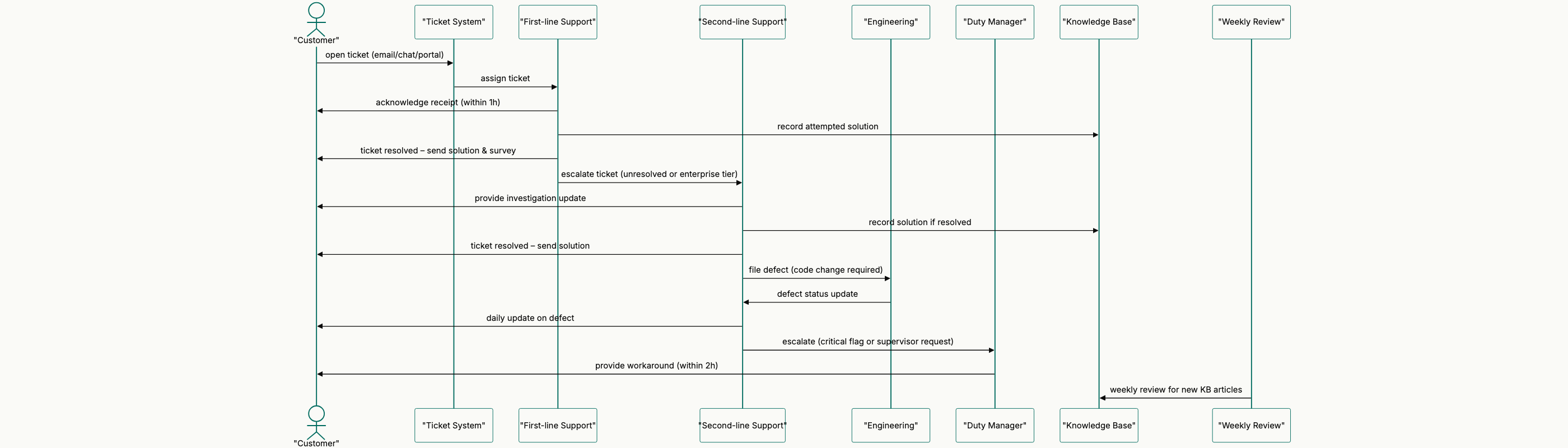
A customer opens a support ticket via email, chat, or the help portal. The first-line agent acknowledges receipt within 1 hour and tries to resolve using the knowledge base. If it is resolved, the agent closes the ticket and sends a satisfaction survey. If the agent cannot resolve it within 4 hours, or the customer is enterprise tier, the ticket is escalated to second-line with full context, who resolve it directly or hand it to engineering as an incident.
Storm2Flow refines that into a precise description with the conditions and handoffs spelled out, so everyone is reading the same procedure.
From that single description, Storm2Flow generates the diagrams that match it, not just one picture:
An incident runbook is only useful if it stays true. In Storm2Flow the description and its diagrams are a living object, not a one-shot export. Show responders the description and its diagrams; they comment on a span of the text or on the whole process, ask questions, and raise flags. You resolve them and evolve the description again, and every saved change is a restorable version.
Compare the As-is response with a To-be target after a painful incident, split the response into subprocesses (detection, mitigation, communication, review), and keep the whole thing in a Space, your team's shared, living process library, so it is the one place responders point at instead of a scattered set of docs.
The payoff for incident management is concrete: a faster, more consistent response because everyone is working from the same understanding, and a living runbook that improves after each incident instead of decaying. New responders onboard from a clear description and matching diagrams rather than tribal knowledge, and the post-incident review feeds straight back into the process model.
See the other scenarios on the use cases page, or read the full picture on the FAQ.